
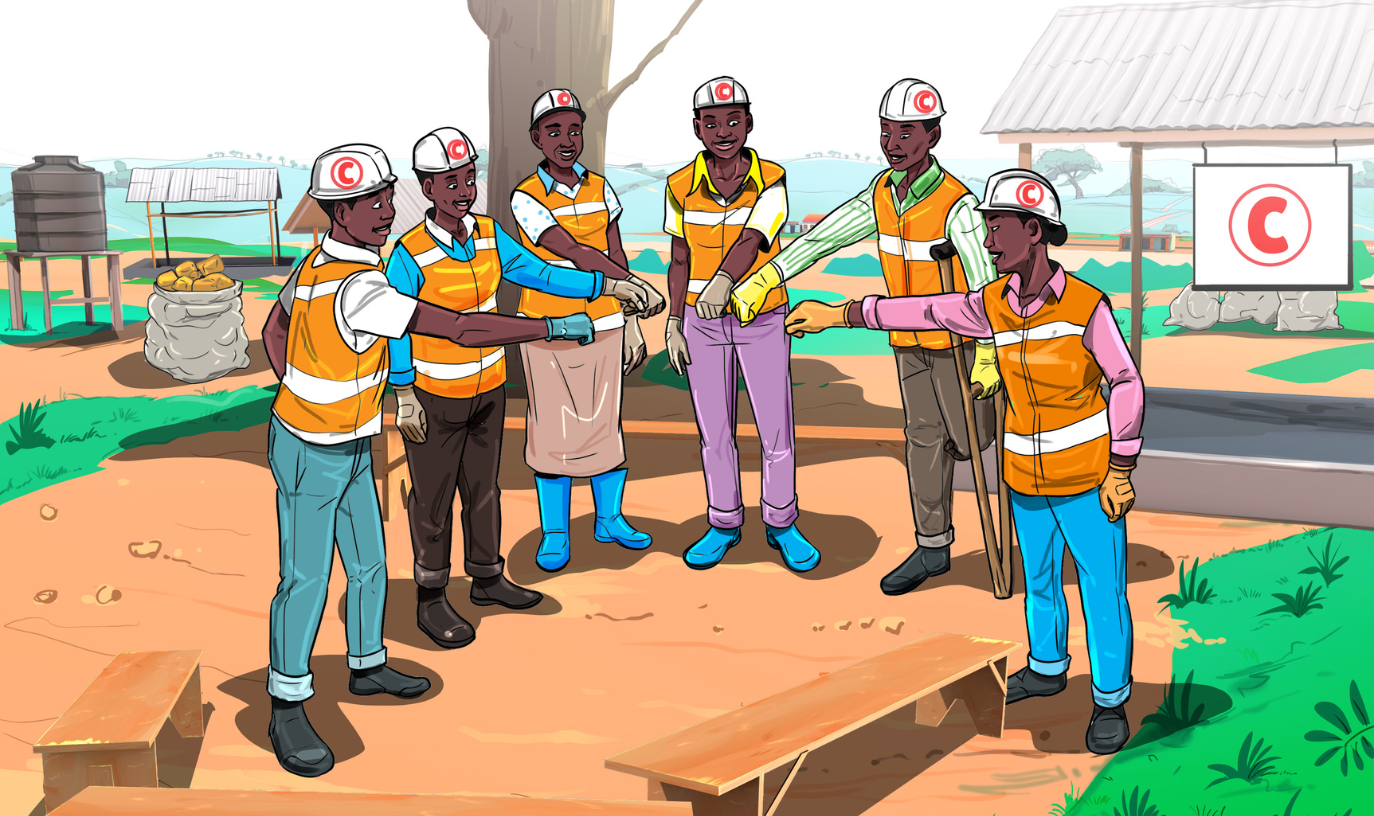
IMPACT has developed a new Toolkit, Understanding Cooperative Values in the Artisanal Mining Sector, to strengthen how cooperatives function and support miners in implementing governance structures that reflect their lived realities.
Cooperatives are a common structure for formalizing the artisanal and small-scale mining (ASM) sector and, in some countries, a legal requirement. While the cooperative model has proven effective in other sectors such as agriculture, its application in ASM has been far more challenging.
The ASM sector is largely informal, with many people working illegally. This has contributed to its perceptions of opacity, complicating efforts to establish transparent and democratic governance structures such as those envisioned by the cooperative model.
In many regions, traditional and customary concepts of authority, land ownership, hierarchy, decision-making, and gender roles are deeply entrenched. Decisions are often made by investors or financial elites within cooperatives rather than through democratic processes among members.
Women and other disadvantaged groups may face barriers to membership and meaningful participation in decision-making. Land and resources may be viewed as belonging to individuals rather than as collective assets. In some cases, cooperative members are unfamiliar with how a cooperative functions or with their rights and responsibilities as members.
These realities often conflict with cooperative values. As a result, the imposition of cooperative structures on ASM actors has frequently led to the creation of cooperatives that are legally recognized but exist only on paper.
This gap between the cooperative model in theory and its implementation in practice is what the Toolkit seeks to address.
The Toolkit
The Toolkit engages cooperatives and their members in conversations around six fundamental cooperative values: self-help, self-responsibility, democracy, equality, equity, and solidarity. These values are essential to strong cooperatives and support responsible mineral governance.
Designed for use in low-literacy contexts, the Toolkit relies on visual tools, hands-on activities, and group discussions.
Through these discussions, cooperative leaders and members can assess how their structures operate in practice and identify gaps between cooperative principles and daily decision-making.
From Structure to Practice
Cooperatives do not automatically lead to inclusive or democratic governance. Without a shared understanding of their purpose and values, they risk becoming formal structures with limited practical relevance for their members.
The Toolkit focuses on strengthening that understanding and supporting more meaningful participation within cooperatives.
This Toolkit was developed following research commissioned by the Public–Private Alliance for Responsible Minerals Trade (PPA) and carried out by IMPACT and Synergy on governance models in the artisanal and small-scale mining sector.
While informed by work in Democratic Republic of Congo and Côte d’Ivoire, the Toolkit is not country-specific and can be adapted across different contexts.
It is intended for artisanal miners, including cooperative leaders and members, as well as those forming cooperatives or participating in other artisanal mining structures such as associations. It is also relevant for civil society organizations, government departments and agencies, and private sector actors working with the ASM sector.
By strengthening understanding of cooperative values at every level, the Toolkit supports more accountable governance structures and more meaningful participation within artisanal mining communities.
Download the Understanding Cooperative Values in the Artisanal Mining Sector toolkit here