The first conflict-free, legal, and traceable artisanal gold to reach the international market from the Democratic Republic of Congo (DRC) was announced in 2017.
That milestone was reached through IMPACT’s ground-breaking Just Gold project.1 It marked a turning point in national, regional, and global efforts to develop and implement a traceability and due diligence system for one of the DRC’s most abundant and conflict-prone natural resources.
For increasingly conscientious international markets to be interested in sourcing artisanal gold from the DRC, the sector must channel its supply through the legal market and provide evidence of due diligence.
However, efforts to move responsible artisanal gold production through legal channels are in direct competition with the illicit gold trade. Even under a brighter spotlight, the illicit gold trade in the DRC continues virtually unabated.
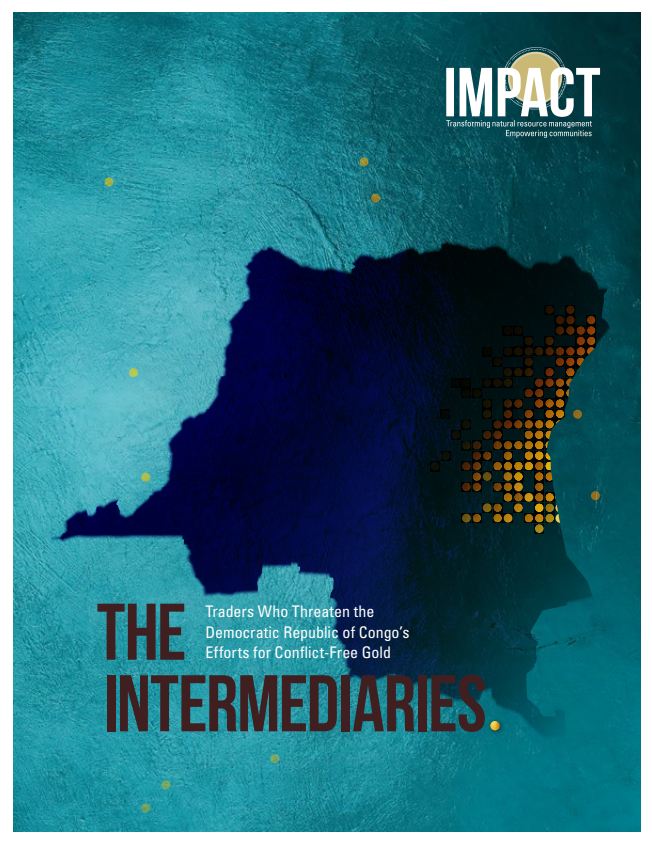
This report examines the illicit gold trade in the DRC and some of the drivers preventing traceability and due diligence systems from being sustainable and scalable. The report focuses on logistical and financial mechanisms, as well as patterns of the illicit gold trade in the eastern DRC provinces of Ituri, North Kivu, and South Kivu. It also explores the conditions that enable illicit trade to continue.
The United Nations Group of Experts on the DRC (UN Group of Experts) has said that most of the country’s gold is being smuggled out. The Group estimates that in 2013, as much as 98 percent of the country’s gold left the country undeclared.2 Reports have also extensively documented how DRC-based armed groups and criminal networks profit from the mineral.3
The international and regional community have stepped up to support efforts to sever links between gold, human rights violations, and conflict. In 2010, through an initiative of the International Conference on the Great Lakes Region (ICGLR), Heads of Member States including the DRC’s President Kabila, Rwanda’s President Kagame, and Uganda’s President Museveni—approved six tools to end the trade of conflict minerals within and between their respective borders.4
A main element of the initiative is certifying conflict-prone minerals—including gold produced or transiting through ICGLR countries as conflict-free. To date, Rwanda, Uganda, Burundi, Tanzania, and the DRC have adopted the Regional Certification Mechanism (RCM) into national law. They have also integrated into their respective legislation the OECD Due Diligence Guidance for Responsible Supply Chains of Minerals from Conflict-Affected and High-Risk Areas (OECD Due Diligence Guidance), which requires the private sector to identify, mitigate, and report any risks, like human rights violations or corruption, in their supply chain.
The OECD Due Diligence Guidance calls on private sector actors to know the origin of the gold they are buying—all the way down to the mine site, even in high-risk contexts like the DRC. Not only should they know where the gold comes from, but the conditions under which that gold was produced and traded. This requires private sector actors to implement supply chain due diligence, including traceability in conflict-affected and high-risk environments, to know whether or not they are contributing to human rights violations, gender-based violence, corruption, or money laundering. According to the OECD Due Diligence Guidance, companies should avoid disengaging with supply chain actors except in cases of serious human rights abuses or support to non-state armed groups.
In reality however, progress to ensure traceable, responsible, and legal artisanal gold supply chains in the DRC’s artisanal gold sector is proving slow.
The flow of conflict-free artisanal gold from the DRC into the international legal market remains limited.5 While IMPACT’s Just Gold project and other artisanal gold traceability systems in the DRC have proven that a chain of custody and due diligence are possible, they have not compelled actors operating outside the project areas to sell legally.
Economic incentives to operate through illicit channels remain too great.
This report examines two main types of illicit gold trade in DRC:
- Well-known traders and exporters who smuggle large volumes over the border without fear of significant consequence
- Informal traders, their role in the local gold economy, and link to pre-financing networks
Through a number of case studies, the report examines the financial and transportation networks of traders and exporters in the DRC and neighbouring countries to understand how they move money and gold.
Some traders and exporters in the DRC are pocketing massive profits from gold smuggling. It’s time to bring these intermediaries out of the shadows they operate in.