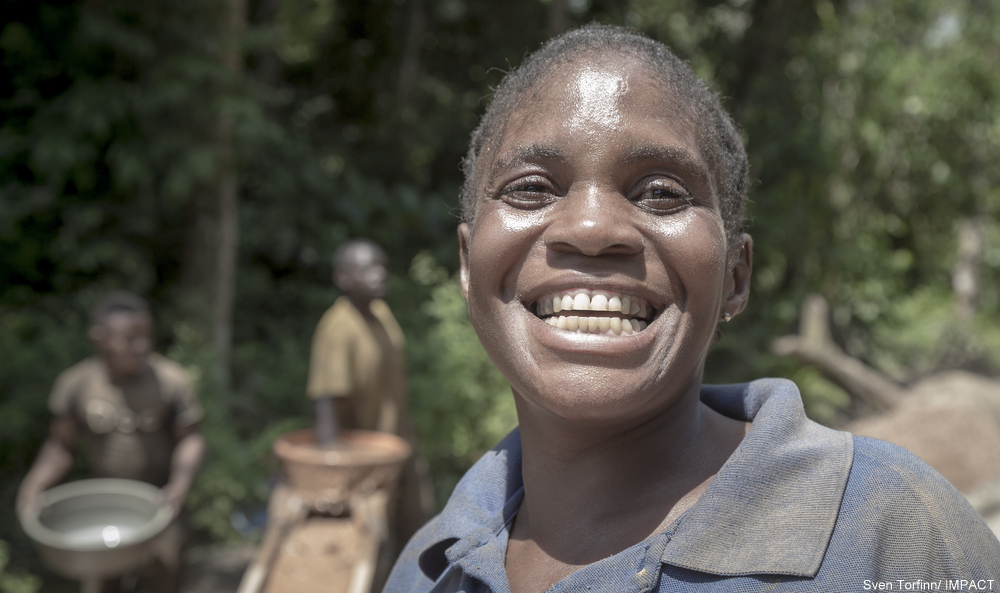
Policymakers from the Ministry of Mines, private sector, and civil society are meeting to address challenges and opportunities for women in the country’s artisanal mining sector
Kinshasa, Democratic Republic of Congo / November 29, 2017
Researchers are kicking off a workshop today to present their research findings on the challenges women face in the artisanal mining sector and opportunities for their empowerment.
The three-year research project led by IMPACT (formerly Partnership Africa Canada), Canada’s Carleton University and the Development Research and Social Policy Analysis Centre (DRASPAC), has explored women’s livelihoods in the artisanal mining of 3Ts (tin, tantalum, tungsten) and gold within Democratic Republic of Congo, Uganda, and Rwanda.
Through surveys, focus groups, life histories, and interviews, the project studied dynamics at two mines in Democratic Republic of Congo—a gold mine in Ituri Province and a tin/tungsten mine in South Kivu.
Policymakers from the Ministry of Mines and the Ministry of Women, women miners, private sector, and civil society attending the workshop will be presented with how gender inequality limits women’s contributions in the artisanal mining sector and their potential as economic and social actors.
“While we have spent many years developing approaches to responsible sourcing of conflict-prone minerals from Democratic Republic of Congo, the role of women in the sector and how they’ve been impacted by these new mining policies, hasn’t been fully understood,” said Gisèle Eva Côté, the lead researcher for IMPACT.
“We now have a fuller picture of the important and diverse contribution women have to artisanal mining, and the actions that need to be taken to support their empowerment,” said Côté.
Researchers found that women in Democratic Republic of Congo face major barriers to equality, with laws and policies contributing to gender discrimination. Despite the fact that the income women earn at mine sites is lucrative and is six times higher than any other activity, they are banned from mining when pregnant regardless of the stage of their pregnancy or state of health.
Women told researchers that this ban was a significant impediment to ensure economic stability for their growing families, with 39% of women in South Kivu surveyed saying they were the sole income earners for their households along with11% in Ituri Province.
The researchers recommend mining policies be reformed to promote gender inclusion at artisanal mine sites, including ending the prohibition against pregnant women working in mine sites.
This project is part of the Growth and Economic Opportunities for Women (GrOW) program, jointly funded by the UK’s Department for International Development (DfID), the William and Flora Hewlett Foundation, and Canada’s International Development Research Centre (IDRC). Additional funding was provided by Global Affairs Canada.
Full findings and recommendations for Democratic Republic of Congo