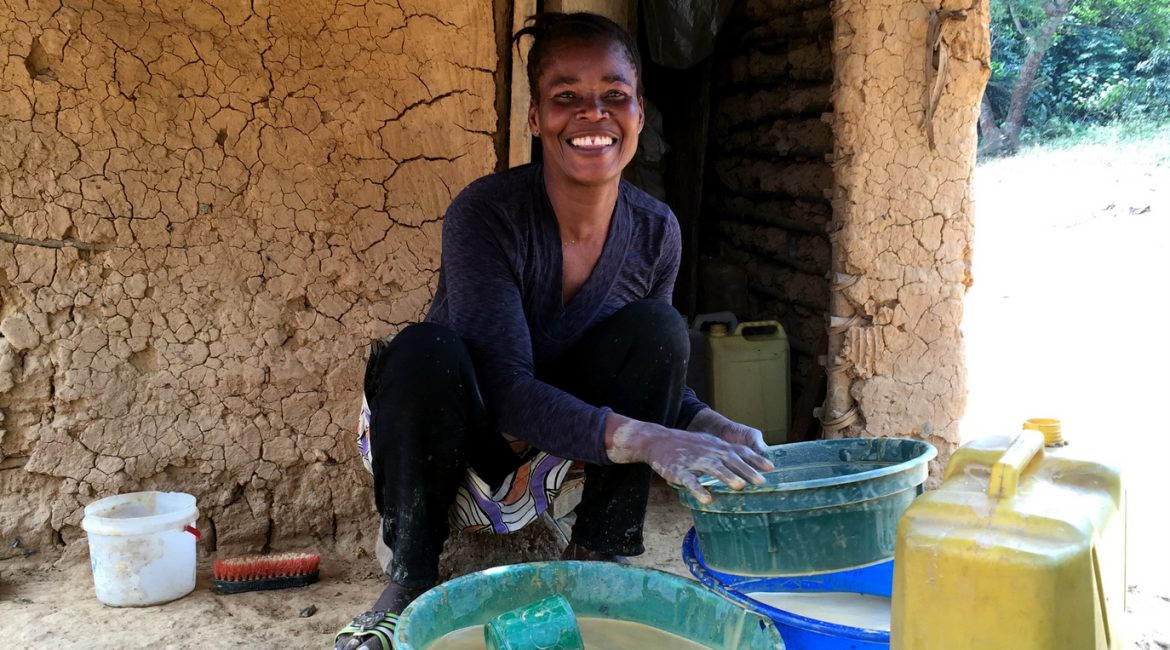
Women are an essential part of artisanal mining. They take on roles from panning and processing to trading goods and services. They rely on the income from this informal mining economy to support their households and dependents. But their diverse participation and challenges to be recognized as economic actors in the ASM sector are most often ignored.
Together with Canada’s Carleton University and Uganda’s Development Research and Social Policy Analysis Centre, we’re exploring women’s livelihoods in the artisanal mining of 3Ts (tin, tantalum, tungsten) and gold within the Democratic Republic of Congo, Rwanda, and Uganda.
Through surveys, focus groups, and interviews, our three-year research project studies dynamics in seven mine sites across the three countries. We aim to reveal how gender inequality limits women’s contributions to the ASM sector and their potential as economic and social actors within the sector.
We’re also examining how policies, regulations, and laws fail to acknowledge gender inequalities within mining communities and make women even more vulnerable. With the three countries at different stages of implementing reforms that target the integration of gender equality into artisanal mining, we’re able to undertake a comparison across the region.
As part of the research project, we’re developing recommendations—based on our key findings and validated by the research participants and artisanal mining communities themselves—for provincial, national, regional, and international policymakers to improve women’s opportunities in the ASM sector.
The Women in Artisanal and Small-Scale Mining in Central and East Africa project is part of the Growth and Economic Opportunities for Women (GrOW) program, which is jointly funded by the UK’s Department for International Development (DfID), the William and Flora Hewlett Foundation, and Canada’s International Development Research Centre (IDRC). Additional funding for the research is provided by Global Affairs Canada. Research began in 2015.